It Works. That’s the Problem.
Almost every homeowner has DIY’d their way out of a sticky situation at some point. And honestly, a quick YouTube video or a good gut instinct can sometimes save you a couple hundred bucks. The trouble starts when DIY becomes the way you keep the power on in your house, and the only proof a job was done right is that the light came on. Most electrical mistakes don’t show up right away. Something as simple as leaving a wire a little loose, or swapping in a bigger breaker so it stops tripping, can leave your wiring running hotter than it should behind your walls, every single day. Months or even years later, something finally gives out. And when it does, the damage can be far worse than you’d ever expect.
Why DIY Electrical Work Feels Safe
The honest truth is electricians cost money and can be hard to book, and a basic outlet swap looks simple in a two-minute video. A recent SupplyHouse survey found that 41% of homeowners had trusted their own instincts or a YouTube or TikTok tutorial over a licensed professional. Most of the time, nothing bad happens. And homeowners believe a safety net is waiting: if something goes wrong, the breaker will trip. That belief isn’t foolish. Breakers stop plenty of overloads and short circuits every day. It’s the reason people feel comfortable taking the cover plate off in the first place.
The Fire Your Breaker Can’t See
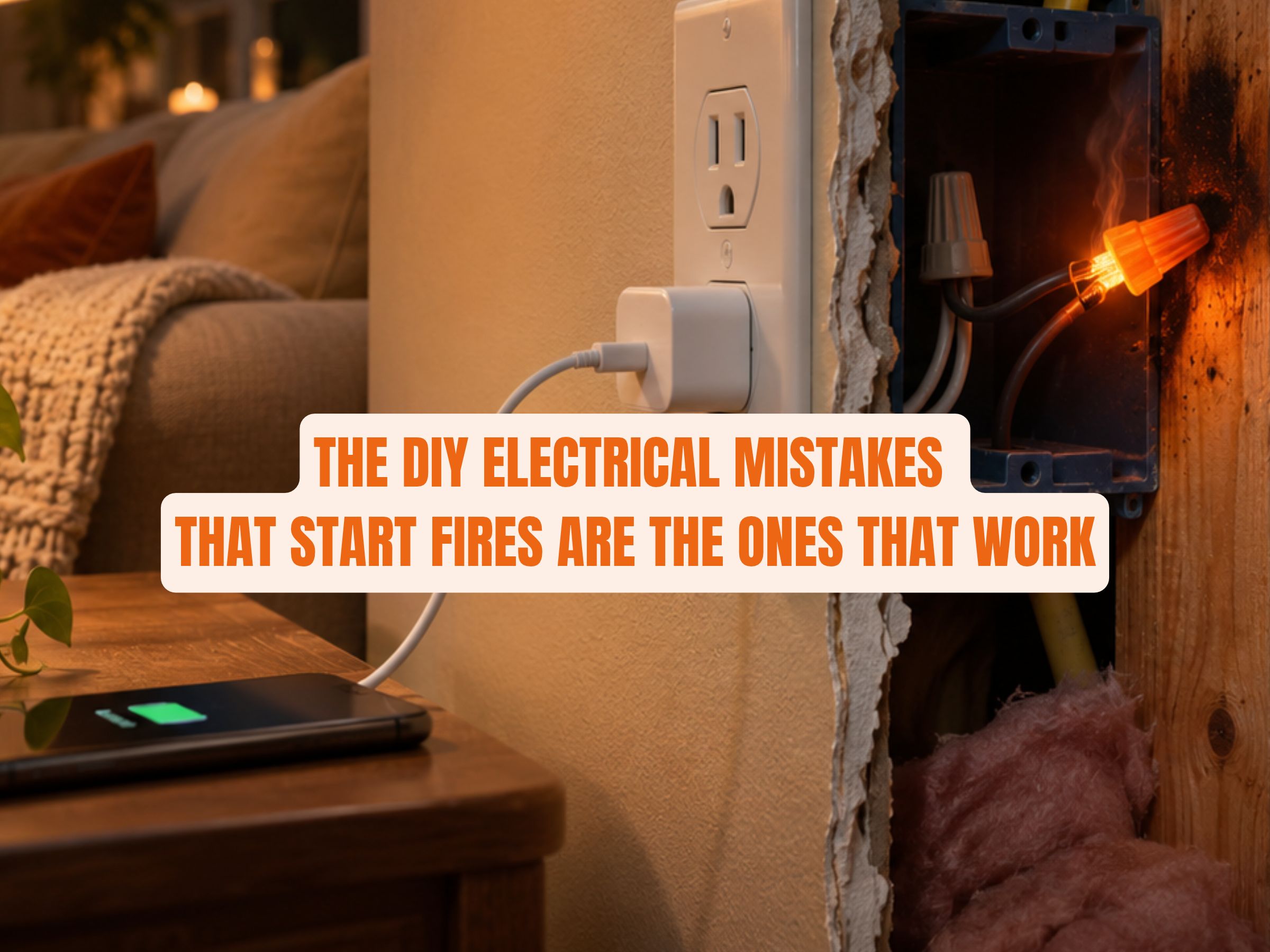
Electrical problems cause about 13% of U.S. home structure fires, and roughly half of home electrical fires involve wiring, outlets, switches and other distribution equipment. Those are exactly the parts DIYers touch. The most dangerous failure in that equipment is when a loose connection develops resistance, and resistance makes heat. Over time the contact oxidizes, the resistance climbs, and the connection can glow red hot while the circuit draws less current than the breaker’s rating. Fire investigators call this a glowing connection. UL’s own standard for arc-fault breakers says those devices aren’t intended to detect it. Forensic engineers say the most common cause is simple: a connection that wasn’t tightened properly. And it can go undetected for days, even years.
Three Mistakes That Pass the Test and Fail Later
1. The connection that’s “tight enough”
When you replace an outlet or switch, there are usually two ways to connect the wires. You can either wrap each wire around a screw on the side and tighten it, or you can push the wire straight into a small hole in the back. The push-in holes are faster, and they’re allowed by code, but most electricians don’t trust them. Every time you use that outlet, the metal inside warms up a little, then cools down when you stop. Over the years, all that warming and cooling can slowly loosen the grip on the wire. Screws can have the same problem if they aren’t tightened all the way. DIYers pick the push-in holes because they’re quicker, and the outlet works right away. But a video can’t show you how tight is tight enough. If an outlet or switch ever feels warm when you touch it, that’s a sign a connection inside has started to loosen.
2. The breaker “upgrade” that removes your protection
A breaker exists to protect the wire. Under the National Electrical Code, 14-gauge copper wire gets a 15-amp breaker and 12-gauge gets a 20-amp breaker. When a circuit keeps tripping, swapping in a bigger breaker looks like the fix, and electricians say homeowners do it all the time. But with a 20-amp breaker on 14-gauge wire, the wire can overheat most often at splices and outlet terminals. This mistake is especially dangerous because what the homeowner has actually done is disable the one safety device that was doing its job. A breaker that keeps tripping is telling you the circuit is carrying more than its wiring can safely handle. The fix is to move some of those appliances to another circuit or have an electrician add a new one, not to install a bigger breaker.
3. Skipping the permit and inspection
When electrical work is permitted, an inspector checks it before the walls are closed up. Most DIY jobs skip that step, so nobody catches the mistake. In a UK survey by Electrical Safety First, 15% of electricians said they had repaired DIY work that caused an electrical fire. And if a fire is traced back to unpermitted work, your insurance claim can get complicated. Take our advice and get the inspection. It’s your only chance to have someone catch a mistake before it’s hidden behind drywall for the next 20 years.
The Fair Objection: Professionals Make These Mistakes Too
They do. Electricians will admit that almost everyone in the trade has left a screw not quite tight at some point. Plenty of homeowners do careful, excellent work, and many jurisdictions allow homeowners to do their own wiring with a permit. Not every glowing connection starts a fire, either. Many simply burn open and stop working. All true. This isn’t an argument that homeowners can’t learn or that professionals are perfect. What you need to know is professional work is checked against code, torque specs and usually an inspector. DIY work is checked against one question: does it turn on? That question can’t detect when a fire is about to break out.
Change the Test: Will It Still Be Safe in Five Years?
Stop asking “Does it work?” Ask “Will this cause a bigger problem in the future?” Call it the five-year test. A job passes when the wire matches the breaker, every connection is made properly under a screw or a rated connector, and someone qualified has looked at it before it disappears behind a wall. Fail any one of those, and the job isn’t finished, no matter how well the light works. The five-year test also changes how you look at a house you’re buying. The previous owner’s weekend projects passed their day-one test too. You inherit the result without the history. If you’ve done your own electrical work, or bought a home from someone who did, have a licensed electrician take a look. Talk to the CES team.
Sources:
- The DIY Home Mistakes That Could Cost You Thousands
- NFPA home electrical fire data
- Electrical Malfunctions a Top Cause of Home Fires
- UL report on AFCIs and glowing connections
- Hidden Heat: High Resistance Connections
- Electrical completed operations fire liability
- Backstab vs Screw Terminal Wiring
- Ask an Electrician
- 14 AWG on 20A breaker
- Younger generations embracing DIY
- DIY Electrical Work Risks
- Burnt receptacle
- Fires caused by poor connections