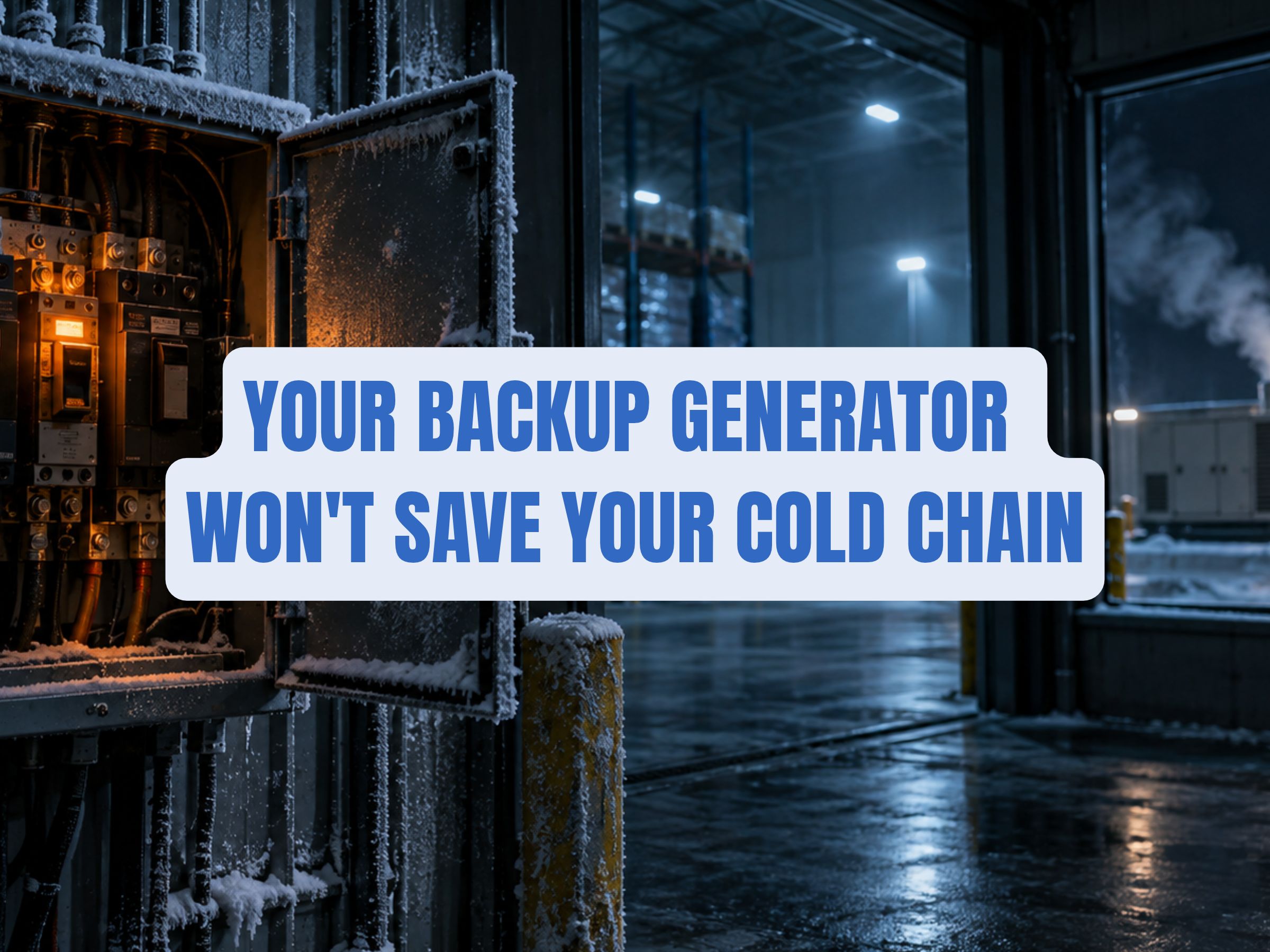
No Matter How Resilient a Power Grid is, it Will Fail.
Ask any food plant manager whether their cold storage is protected from an outage, and most will proudly point at the generator out back. Why? Because it’s been periodically tested, fueled up, and it starts up seconds after an outage happens. Great right? That is the most expensive assumption in the cold chain.
A generator is just an engine, utility to transfer switch, transfer switch to switchgear, switchgear to the compressors that actually hold your product at temperature. Every link in that path can fail while the engine runs perfectly. And in cold storage, the majority of spoilage after an outage starts happening within the first three hours. You rarely get a second chance. The question isn’t whether you have a generator, but whether you are prepared if the power goes out for more than a day.
Why “buy a generator” became the default answer
Outages are getting longer and harder to predict, and the Global Cold Chain Alliance has pointed out that restoring power to 90% of customers can take anywhere from 17 hours to 87 days, and that simply keeping the doors shut is no longer a plan. A standby generator is the obvious answer. It’s something you can point to: auditors can see it on a checklist, and insurers can see it on a policy form. Generator dealers now describe backup power for cold storage as mandatory, not optional, and few operators would argue. The people who hold this view aren’t wrong about the risk. They’re right that a facility without backup power is gambling with its inventory. The problem is what happens after the purchase order is signed.
When backup power meets a real outage
In February 2021, Winter Storm Uri gave Texas a live test of backup power at scale. A KHOU investigation found that one in five of the City of Houston’s backup water generators did not operate as intended. Ten units would not start remotely because of system faults, and the operator said breakers had not been configured correctly to switch to backup. At other sites, inspectors logged switchgear and breaker problems, an antiquated unit, and batteries that would not start in the cold. Almost none of those failures were about the engine itself. An NREL analysis of emergency diesel generator data found that standard reliability metrics are poor predictors of performance during a real grid outage. So even a well-maintained single generator was only about 80% likely to keep power on through a two-week outage. What does this mean? A generator that starts on test day is not the same as a system that carries your compressors for three days.
Three reasons the generator isn’t the weak link
1. A generator is a product, but power resilience is a system
When a generator arrives, the path it feeds doesn’t usually come with it. The transfer switches, switchgear, breaker coordination, controls, and the refrigeration panels themselves are often installed at different times by different trades. What this means is the engine is the most visible, most serviced part of the system, so it gets the attention. The connections between the parts get a fraction of that scrutiny, even though that’s exactly where the Uri failures happened. For a cold storage operator, that means your backup plan is only as good as the least-inspected panel between the generator and the compressor.
2. Passing the test isn’t surviving the storm
Passing periodic tests is a compliance artifact, and it takes a lot more to guarantee better performance. If your facility has never transferred the full refrigeration load and held it for hours, you don’t know your ride-through capacity. You’re assuming it. Most routine generator exercising is short and runs at partial load, which doesn’t prove the system can pick up several large compressor motors at once, survive their inrush, sequence defrost and evaporator fans, and then hold steady for 72 hours. Being available, starting, and running for the full outage are three different questions, and most routine tests only answer the first.
3. Nobody owns the whole path
Ask who is responsible for cold storage resilience, and what you’ll have is the electrician who installed the transfer switch, the contractor who works on the compressors, the controls integrator that programmed the PLC years ago, the maintenance guy who keeps the generator log, the QA guy who does the HACCP, and finance owns the insurance policy. Each one sees a piece, and nobody is accountable for the whole path from utility to compressor.
Many food safety professionals argue that a power outage isn’t a HACCP hazard at all, because it isn’t “reasonably likely” in the FDA sense. Insurance often feels like the backstop, yet trade press has warned that many business interruption policies do not cover outage-related spoilage. This means that either an in-house engineer or an outside electrical partner has to be accountable for the whole path from utility feed to compressor and test it as one system. Until that happens, the gaps between the pieces are where six-figure losses come from.
The fair objection: generators usually work
Now we can agree that most outages are short, many end well inside the three-hour window, and a closed, well-sealed freezer rides them out with no help at all. Hospital surveys have found emergency power systems starting successfully around 98% of the time. Redundant generators, full-load testing, and integration studies all cost real money.
All true. This isn’t an argument against generators, or for buying more of them. It’s an argument for proving if your system can carry the full refrigeration load for days. Most outages are short and do no harm. It’s the rare multi-day outage that wipes out inventory and customer trust in a single weekend. Start reliability and ride-through reliability are different numbers. In cold storage, the money is lost in the long-tail, multi-day shortage that a monthly test doesn’t prepare for.
Measure hold time
Hold time is the proven number of hours your facility keeps product in spec during a grid outage, measured end to end. It counts the generator, the transfer, the switchgear, the restart sequence, the controls, and the thermal mass of the building and product itself. A facility with a smaller generator and a tested, well-sequenced path can have a longer hold time than one with a bigger engine and an untested switch.
Hold time also changes what cold storage is worth. Facilities that know exactly how long they can coast without power can sell that flexibility. Lawrence Berkeley National Lab found that refrigerated warehouses that pre-cool and shed load during peak periods can see paybacks of 2 to 4 years from demand-response programs. There’s a limit: coolers above freezing, holding produce, dairy, or meat, usually have too narrow a temperature band to play.
The same knowledge that protects your inventory in a storm can earn money on an ordinary Tuesday. You only get either if you measure it.
The question your auditor won’t ask
No auditor will ask you to prove your hold time. No insurer will test your transfer switch under full refrigeration load. The generator log will look clean right up to the morning it matters. The facilities that come through the next long outage intact won’t be the ones with the biggest generators. They’ll be the ones that stopped trusting the box out back and started testing the path behind it. So here’s the uncomfortable question: if the grid went down tonight, do you know your hold time?
Find out before the grid does. CES designs, tests, and maintains the full power path for food and beverage facilities, from service entrance to compressor. Talk to our team about a backup power assessment.
Already dealing with an outage? Our emergency electrical team can help.
Sources:
- How to tackle power outages in the food, beverage industry (Refrigerated & Frozen Foods): three-hour spoilage window, insurance gap
- Beyond Closing the Doors (GCCA): 17 hours to 87 days restoration range
- Warehouse Backup Power (Generator Source): backup power framed as mandatory
- 20% of back-up water generators failed during winter storm (KHOU 11): Winter Storm Uri failures
- Reliability of emergency and standby diesel generators (NREL, Applied Energy): 80% two-week figure
- Survey: The Effects of Hurricane Sandy on Critical Facilities (FacilitiesNet): distribution vs. generator failures
- Emergency electrical systems survey (ASHE): hospital start-up reliability
- Unforeseen Hazard of a Power Outage (IFSQN forum): QA view on HACCP
- Refrigerated Warehouse Demand Response Strategy Guide (LBNL): 2 to 4 year payback
- Demand Response: Refrigeration Warehouse Controls (Regional Technical Forum): coolers above freezing as poor candidates