Short answer: Yes and No.
This is a question a lot of facility owners are asking right now, usually while standing in a warehouse or plant that has run just fine for 30 years: is this building getting too old for what we need it to do?
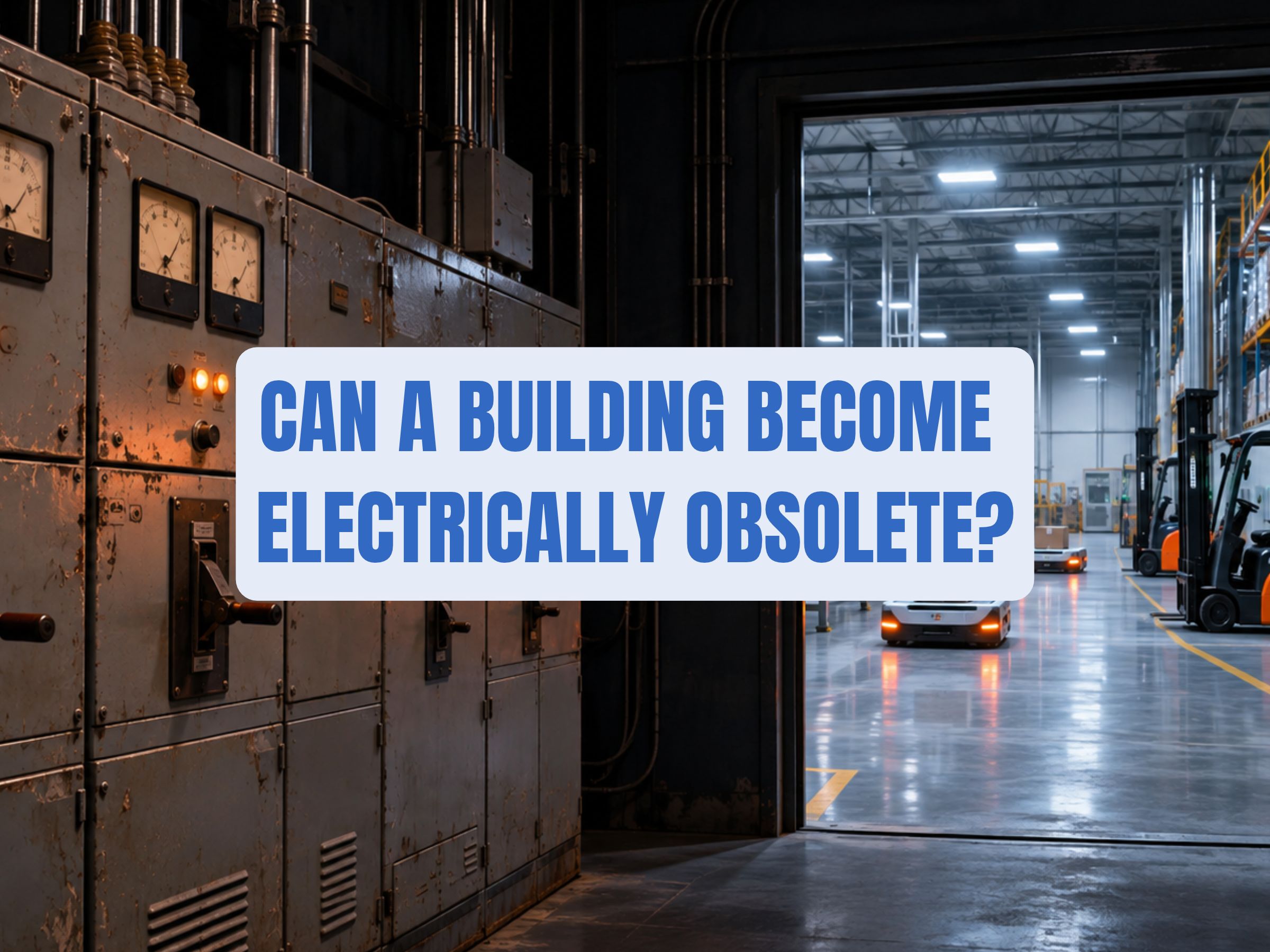
It’s a fair question because the equipment still works, the lights come on, the conveyors run and the compressors cycle. But the business inside the building looks nothing like it did when the electrical system was designed. There are robots where there used to be pallet jacks, chargers where there used to be propane tanks, and machines that pull far more power than the original engineer ever planned for. So can a building actually become electrically obsolete? The honest answer is yes and no. Let’s talk through both sides.
Why the Answer Is No
Well-built electrical equipment lasts a remarkably long time. Medium voltage switchgear often stays in service for more than three decades. BEAMA, a UK electrical manufacturers’ association, says transformers have been known to last 80 years or more and switchgear 50 years or more.
Some people in the industry think that’s just the start. Finley Ledbetter, CEO and chief scientist at Group CBS, an electrical equipment testing and service company, has spent 45 years in power engineering. In NETA World, the electrical testing industry’s journal, he points out that most of America’s 480-volt to 15-kV equipment was installed in the 1970s and early ’80s, and argues the industry should plan to keep it running for 100 years or more through life-extension work. That’s less wild than it sounds. Instead of ripping out an entire lineup, many facilities now retrofit older breakers with modern ones that fit the existing gear. Nelson Squires, an executive vice president at electrical distributor Wesco, says this kind of modernization can avoid 60-week lead times and extend equipment life by up to 30 years.
So if “obsolete” means worn out and ready for the scrapyard, most buildings aren’t there. The steel, copper and bus bars behind your walls can keep doing their job for a very long time.
Why the Answer Is Also Yes
Here’s the catch. Equipment can last for decades and still stop being the right equipment. That usually happens in one of three ways.
- Parts run out. Once a manufacturer stops making or selling replacement parts for a breaker or panel, every failure turns into a scavenger hunt. A part that used to take a day to order can take weeks, and those weeks are downtime.
- Capacity runs out. Your electrical service was sized for the load the building had when it was designed. Add enough new equipment and you run out of room, even if every component is in great shape.
- Heat wears things out faster. Electrical insulation ages faster when it runs hot. The rule of thumb from Siemens’ technical guidance is insulation life drops by half for every 10°C rise in temperature. By that math, switchgear run fully loaded might last about 10 years, while the same gear at 80% load can last around 40. A building that keeps adding load gets closer to its limit and wears out its equipment faster along the way.
So yes, a building can become electrically obsolete. Age is rarely the reason. The work it’s being asked to do has simply outgrown the system it was built with.
Where the Experts Disagree
Nobody serious argues that old gear should run until it breaks. But there need to be detailed site studies before any replace-or-retrofit decision. Letting equipment run to failure can leave a facility down for months. The real debate is about what to do before that point. On one side are the life-extension advocates. Test it, maintain it, retrofit the breakers and keep the bones. On the other side are people who say some systems simply weren’t designed for today’s loads, and that patching them only pushes a bigger bill down the road.
In 2026 there’s a twist that makes the decision harder. If you do need more power, getting it isn’t quick. High-voltage transformer lead times that ran 24 to 30 months before 2020 now stretch as long as five years. Utilities can also take years to connect large new loads in some regions, while the same project might get connected in months somewhere else. That makes “keep what you have and make it last” more attractive, and it makes planning ahead more important than ever. Our view sits in the middle. The age of your equipment matters less than the gap between what it was designed for and what you’re asking it to do today.
What It Means for Warehouse Owners
For decades, a typical warehouse ran on electrical service in the 1,000 to 1,500 amp range. That was plenty for lighting, HVAC and a few dock doors. It’s often not enough for what’s moving in now. Electric forklifts now hold about 70% of the forklift market. In Modern Materials Handling’s 2026 automation study, 35% of warehouse operators surveyed had adopted automated guided vehicles, and average automation spending per facility rose to $1.6 million. Add conveyors, sortation systems, robotics and EV charging for delivery fleets, and the load picture changes completely. One commercial EV charging installer estimates that 40% to 60% of a warehouse charging project’s cost goes to service upgrades, transformer work, switchgear and conduit, not the chargers themselves.
That’s why industrial real estate firm Link Logistics advises tenants to run a formal load calculation before committing to a space or requesting a utility upgrade, and to size for where the operation is headed, not just where it is today. Cold storage sits at the top of the demand scale. A refrigerated warehouse that adds automation or an electric fleet can hit its limit sooner than almost any other building type.
What It Means for Factory Owners
Manufacturers face the same problem with higher stakes. After nearly two decades of flat electricity demand, the U.S. is seeing new load growth driven by reshored manufacturing, process electrification and data centers. Factories are swapping gas-fired processes for electric ones and adding more automation and more sensitive controls along the way.
Food and beverage plants feel this in a particular way. They run refrigeration, washdown equipment and production lines that can’t tolerate interruptions, often in buildings that have been expanded several times. Each expansion tends to tap into whatever capacity was left over, so plenty of plants are running closer to their limits than anyone on the floor realizes. And because new utility capacity can take years, a factory owner who discovers the gap halfway through an expansion project may be facing a long and expensive wait.
So, Is Your Building Obsolete? Four Questions to Ask
- What’s your actual peak load compared with your service capacity? If nobody has measured it recently, that’s the first job.
- Can you still buy new parts for your main switchgear and panels? If the answer is “only used or refurbished,” it’s time to start planning.
- What’s coming in the next five years? New lines, automation, electric forklifts and fleet charging all count.
- When was your equipment last tested? Maintenance records tell you whether your gear is aging normally or running hot.
If you’re comfortable with all four answers, your building probably isn’t obsolete. If you’re unsure about two or more, it’s worth a closer look.
Where CES Comes In
This is exactly the kind of question CES helps facility owners answer. We start with what you have: measuring your real loads, checking the condition of your service entrance and distribution equipment, and flagging gear that’s getting hard to support. Then we look at where your operation is headed and map out the most practical path. Sometimes that means retrofitting what you already have. Sometimes it means adding capacity in stages, or planning a bigger upgrade well before you’re stuck waiting on the utility. We’re not out to replace everything. We want your building to keep up with your business. Wondering whether your facility is falling behind? Talk to CES about an electrical capacity assessment.
Sources:
- How to Modernise Ageing Switchgear
- Asset Expected Life for Transformers and Switchgear
- Life Extension: The Big Picture
- Three Best Practices for Switchgear Modernization
- Electrical Obsolescence case study
- Treat Your Electrical Equipment Like Your Automobile Tires
- Extending switchgear life span
- Manufacturers and Data Centers Compete for Megawatts
- Power grid timelines
- Warehouse Power Infrastructure Is Redefining Leasing
- Forklift Market Research Report
- Forklift Market Report: automation data
- Light industrial EV charging
- Warehouse Power Capacity
- Why Industrial Developers Are Turning to On-Site Energy