A few years ago, the idea of a manufacturing plant generating its own power sounded like something out of a Silicon Valley futurist’s deck. Big tech companies and data centers were the only ones taking it seriously, and even then, most of the conversations were theoretical. That’s changed fast. Walk into a serious facility planning meeting today, and the question isn’t “should we ever consider on-site power generation?” It’s “when does it make sense to start?”
In 2026, behind-the-meter power generation has moved from data center luxury to mainstream industrial strategy. Manufacturers, warehouses, food and beverage operations, and cold storage facilities are quietly building infrastructure that enables them to generate, store, and use power without ever connecting to the utility grid. The reasons are financial, operational, and increasingly strategic. Let’s get into what’s driving it, how it actually works, and whether it might make sense for your facility.
What “behind-the-meter” actually means (and why it matters now)
Quick vocabulary check before we go further. “Behind-the-meter” (or BTM) means any power generation, storage, or management system installed on the customer side of the utility meter. The opposite is “front-of-meter,” which is utility-side infrastructure. In practical terms, BTM means:
- You generate power on-site (solar, generators, fuel cells, etc.)
- You may store some of that power (battery systems, thermal storage)
- You use the power directly without it being sold back to the utility or traveling through their distribution system
A few common configurations:
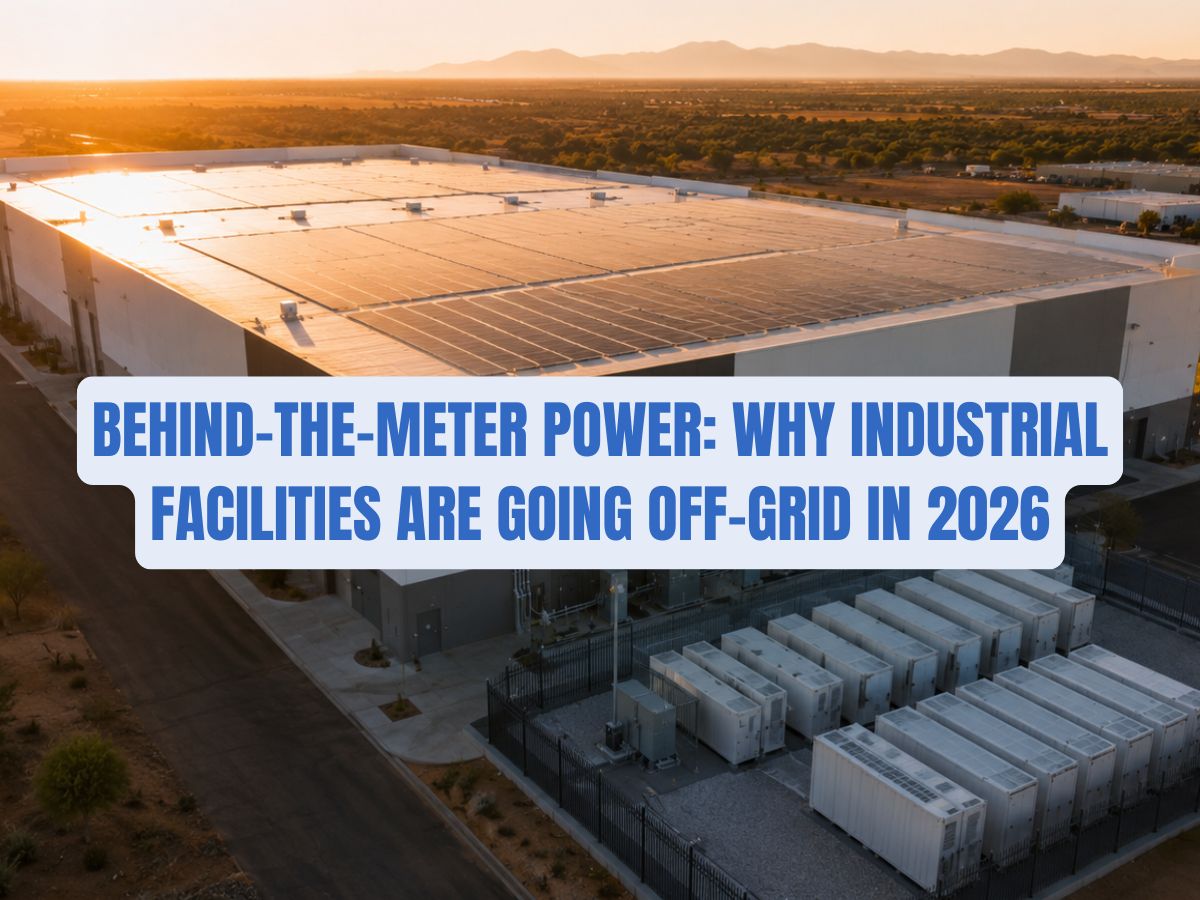
- Solar + battery storage: daytime solar generation paired with batteries to use stored power during peak rate hours
- On-site natural gas generators with smart switching: run during peak periods to reduce demand charges, plus full backup capability
- Microgrids: integrated systems that can island off-grid during outages and run independently
- Demand response + battery: partner with your utility to reduce grid demand during peak periods (and sometimes get paid for it)
Some facilities go fully off-grid; most don’t. The smarter play for most operations is a hybrid setup that maintains a grid connection while minimizing reliance on it during the expensive hours.
Why is this moving from data center luxury to mainstream strategy
1. AI data centers led the charge
The data center sector basically created the modern BTM playbook. Faced with multi-year delays getting grid interconnections approved, and needing 24/7 ultra-reliable power for AI workloads, hyperscale operators stopped waiting on utilities and started building their own power on-site. Some of those facilities now run on natural gas turbines, solar farms, and battery storage, with the utility connection serving as backup rather than primary supply. The economics that work for a 1 GW data center don’t all scale down to a 50 MW manufacturing plant. But the proof-of-concept is there, the technology is mature, and the cost curves for batteries and solar have come down dramatically.
2. Equipment lead times made grid expansion impossible
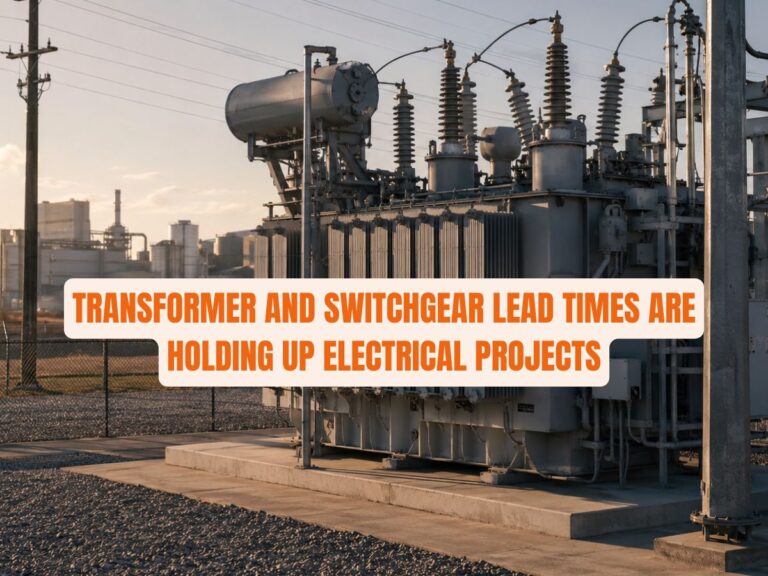
We covered this in our post on rising electrical bills, but it’s worth repeating here. Lead times for grid equipment like transformers and switchgear have stretched to multiple years. That means if your facility needs to upgrade service to bring on new equipment, or you’re a growing operation that needs more power capacity, the utility may quote you a four-year wait. Or longer. Behind-the-meter generation lets you bypass that bottleneck entirely.
3. The economics finally tipped
Solar panels are now roughly half the cost they were a decade ago. Lithium-ion battery storage is about a third of its 2015 price. Natural gas generators with smart switching infrastructure have gotten dramatically more sophisticated. And the cost of grid electricity keeps climbing. The crossover point, where on-site generation costs less per kWh than utility power, has been hit in many markets. With proper financing and tax credits, payback periods for solar + storage in industrial applications are now commonly in the 5–8 year range. For larger systems with demand response participation, payback can be shorter.
4. Outage costs forced the conversation
When industrial facilities started running the math on the cost of an unplanned outage, the answer was sobering. Recent industry surveys show more than half of major outages now cost facilities over $100,000. One in five outages costs more than $1 million. When your downside scenario is a six- or seven-figure loss from a single grid event, paying for resilience starts looking less like an expense and more like insurance.
The four ways industrial facilities go behind-the-meter
1. Solar + battery storage
Solar makes sense for facilities with significant daytime energy use and either a large roof or surrounding land. Pair it with battery storage, and you can shift solar generation into the expensive evening peak hours — which is where most utility demand charges are concentrated. Best fit: warehouses, distribution centers, light manufacturing, and food and beverage facilities with significant refrigeration loads.
2. On-site natural gas generators with smart switching
Modern industrial generators paired with smart switching infrastructure can do far more than emergency backup. They can run during peak demand hours to shave your demand charges, support critical loads during voltage events, and provide full islanding capability during outages. This is one of the most flexible approaches, and the technology has matured significantly. We covered more of this in our post on why backup generators matter more than you think. Best fit: 24/7 operations where any downtime is expensive — manufacturing plants, cold storage, food processing.
3. Full microgrids
A microgrid integrates multiple power sources (solar, batteries, generators, sometimes fuel cells) with smart controls that automatically optimize what’s running, when, and how. The system can island off-grid during outages, ride through power quality events, and participate in utility demand response programs. This is the most sophisticated approach and the most expensive upfront, but it delivers the highest level of operational resilience. Best fit: large facilities with critical operations, multi-building campuses, and mission-critical food processing.
4. Demand response + battery storage (no on-site generation)
You don’t have to generate any power to benefit from a behind-the-meter strategy. Battery storage alone, charged from the grid during off-peak, low-cost hours and discharged during peak, high-cost hours, can dramatically reduce demand charges. Pair it with a utility demand response program, and you may actually get paid to reduce your grid draw during peak events. Best fit: facilities that can’t host on-site generation but want immediate ROI on energy costs.
The real economics (it’s not just about cheaper kWh)
This is where most facility managers initially get it wrong. The case for behind-the-meter isn’t primarily about lower per-kWh costs. It’s about the combination of:
- Demand charge reduction. Many commercial and industrial rate structures charge based on your peak demand (the highest 15-minute draw of the month), not just total energy used. Shaving even 10% off your peak demand can cut your bill substantially.
- Outage avoidance. If you can keep production running through grid outages without stopping, the financial impact is enormous. For some operations, one prevented outage pays for years of infrastructure.
- Power quality protection. Battery-backed systems naturally smooth out grid disturbances. As we discussed in our post on the power quality crisis, this can prevent the kind of micro-disruptions that compound into millions in lost production over time.
- Demand response revenue. Many utilities now pay facilities to reduce their grid draw during peak events. For facilities with battery storage or flexible loads, this can become a meaningful revenue stream.
- Tax credits and incentives. The current federal investment tax credit, bonus depreciation, and various state-level incentives can cover 30–40% of system costs. Plus utility rebates in many regions.
What you need to think about before pulling the trigger
- Site assessment. Available roof or land area, structural capacity, shading, existing electrical room space, and conduit pathways. Some facilities have great BTM potential; others have hard constraints.
- Existing electrical infrastructure. Your service entrance, switchgear, panel locations, and grounding all matter. Some facilities need significant infrastructure upgrades before BTM equipment can be properly integrated.
- Permitting and interconnection. Even when you’re generating your own power, you typically still have a grid connection — and the utility has rules about how your generation interacts with their system. Getting interconnection approval can take months, sometimes longer.
- Tariff structure analysis. Your utility’s rate structure determines what economic benefits you can actually capture. Demand charges, time-of-use rates, demand response programs, and net metering policies.
- Maintenance and operations. Solar panels need washing. Batteries have warranties and replacement cycles. Generators need exercise runs, fuel deliveries, and emissions monitoring. Plan for long-term maintenance, not just the install.
When it doesn’t make sense (be honest)
Behind-the-meter isn’t right for every operation. A few situations where it’s probably not the right move:
- Very small facilities (under ~100 kW peak demand) where the fixed costs of design and equipment don’t get amortized over enough usage
- Facilities in markets with very low utility rates (some industrial-friendly regions still have rates under $0.07/kWh)
- Constrained sites with no roof access, no available land, and limited electrical room space
- Short remaining lease terms without owner cooperation, most BTM systems have 7–15 year payback windows
- Operations that don’t have peak demand patterns worth optimizing against
The honest answer: BTM makes sense for somewhere between 30–60% of mid-size and large industrial facilities, depending on the market. Not every facility, but a lot more than they have today.
Where to start (without breaking the budget on day one)
You don’t have to install a full microgrid next quarter. The smart path for most facilities looks like this:
- Get a real energy audit and tariff analysis to understand where your money is actually going
- Address the low-hanging fruit first, LED retrofits, power factor correction, controls upgrades that reduce demand without any generation
- Run a behind-the-meter feasibility study to model what makes sense at your facility
- Start with one phase, usually battery storage or a properly sized solar array, whichever has a shorter payback
- Plan for additional phases as the economics and your facility needs evolve
Most facilities don’t go fully behind-the-meter in one move. They get there in 3–5 year increments, with each phase paying for the next.
The bottom line
The conversation around on-site power generation has fundamentally shifted in 2026. What used to be a niche conversation for data centers and mission-critical operations is now a real strategic question for any industrial facility paying attention to its bills, its uptime, and its long-term competitive position. The facilities making moves now are doing so for very practical reasons: lower energy costs, protection against outages, immunity from voltage events, and a hedge against the rising cost of grid power. The ones who wait are likely to find themselves paying more for less reliable power while their competitors enjoy stable costs and stable operations. You don’t have to commit to going fully off-grid. But you should be asking whether some piece of this strategy makes sense for your facility because the math, the technology, and the policy landscape all point to this being the moment.
Start with a real conversation
If you’ve been thinking about on-site power generation but aren’t sure where to start, or you’ve been quoted by solar installers and want a contractor’s honest read on what makes sense, that’s the conversation we’re built for. Conveyor Electrical Services works with manufacturing, warehousing, and food & beverage facilities to assess behind-the-meter opportunities, plan and install resilient electrical infrastructure, and build long-term power strategies that protect margins as costs climb. Whether you need a feasibility study, full microgrid design, or just a smart second opinion on a vendor’s proposal, we’re here.
Request a Behind-the-Meter Feasibility Assessment or call us at 256-403-2218 to start the conversation.