It’s not your equipment.
You’ve seen it happen. A drive trips for no apparent reason. A PLC resets in the middle of a production run. A motor that’s been humming along for years suddenly starts pulling more current than it should. The maintenance team can’t find anything wrong with the equipment itself. The breakers don’t show overload. So you reset everything, get the line running again, and try to forget about it. Then it happens again and again. There’s a real power quality crisis hitting manufacturers in 2026, and most facility managers don’t have the language for what’s going on. “Power quality” is a vague-sounding term that covers a few very specific issues. Let’s talk about it:
- Voltage sags: brief drops in voltage (usually a few cycles) that cause sensitive equipment to trip offline
- Voltage swells: brief spikes above normal voltage that stress insulation and damage components
- Harmonics: distorted waveforms caused by VFDs, LED drivers, and switching power supplies that overheat transformers and degrade motors
- Transients: fast voltage spikes from lightning, switching events, or grid disturbances that punch holes in your equipment
- Voltage imbalance: uneven phases that cause motors to run hot, reduce efficiency, and shorten lifespan
- Frequency variation: small wobbles in the 60Hz frequency that cause sensitive automation to misbehave
Why this got worse in 2026 (and why it’ll keep getting worse)
Three things are converging right now that didn’t used to converge.
1. Demand is growing faster than the grid
NERC’s 2026 Long-Term Reliability Assessment is projecting peak demand growth approaching 5% annually in some regions of the U.S. Driving that growth: AI data centers, broader electrification, and industrial expansion. As a result, feeders that used to operate well within their capacity are now running close to the edge. When a feeder is operating near maximum, disturbances don’t get absorbed the way they used to. A neighboring facility starting a large motor, a brief weather event, or a switching operation upstream can create voltage sags that propagate down the line and reach your plant.
2. Your equipment got more sensitive
Equipment that comfortably absorbed a 15% voltage dip a decade ago now trips offline at a 10% dip because automation has gotten more sophisticated. Modern VFDs, PLCs, servo drives, and automated machinery are designed with tighter operating tolerances because they are regulating to precise specs that older mechanical equipment never needed to hit. The trade-off is that they need cleaner power to work, and they trip offline sooner when they don’t get it. So you’ve got a grid that’s becoming less stable at the exact moment your equipment has become less tolerant. That’s the crisis in one sentence.
3. Aging infrastructure can’t ride through as it used to
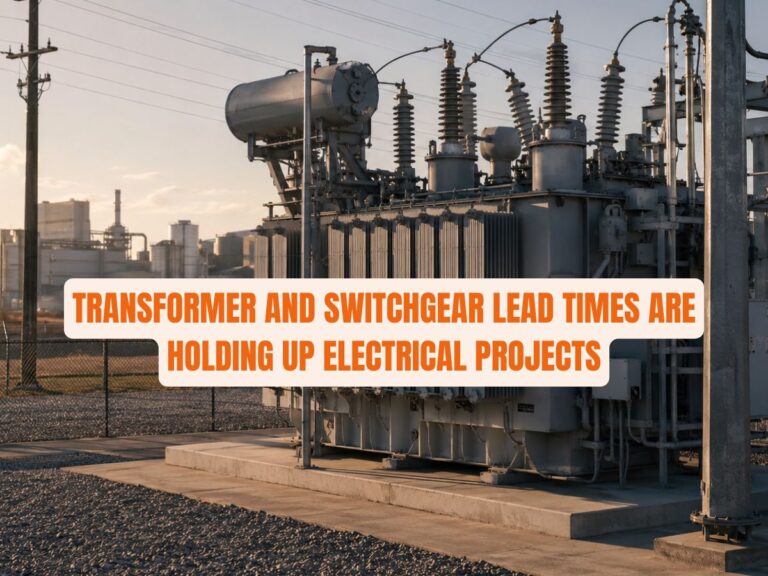
Add one more factor: the physical equipment between you and the grid is older. Utility transformers, substations, and distribution equipment in many parts of the country are running well past their original design life. And as we covered in our recent post on rising electrical bills, lead times for replacement equipment have stretched to multiple years. Older infrastructure is more vulnerable to disturbances. Less reliable utility-side equipment means more sags and outages reach your facility. The whole chain is less forgiving than it was even five years ago.
The signs you’re paying for power quality problems right now
How do you know if power quality is hitting your operation? Here are the most common signs:
- Random equipment trips with no clear cause, drives, PLCs, and contactors dropping out for no apparent reason
- Recurring failures of specific components, such as capacitors, drive boards, and motor windings, are burning out more often than they should
- Production line resets during otherwise stable operations
- Higher than expected energy bills, poor power factor, and harmonics show up here, especially in demand charges
- Hot panels and overheating equipment harmonics generate heat that’s not doing useful work
- Lights flickering when large equipment starts sign of voltage dips reaching your service
- Increased maintenance frequency on motors, drives, or sensitive electronics
The real cost of repeated trips
- Lost production minutes add up fast. A 30-second trip that requires a 5-minute restart, happening twice a day, adds up to over 60 hours of lost production per year. On a high-throughput line, that’s six-figure losses you’re not even tracking.
- Equipment lifespan shortens dramatically. Voltage transients punch microscopic holes in insulation. Harmonics cause continuous low-grade overheating in motors and transformers. Phase imbalance reduces motor efficiency by 10–15%. Components rated for a 20-year life can fail in 8–10 years when they’re constantly fighting power quality issues.
- Energy waste shows up on every bill. Poor power factor means you’re paying for kVA your facility isn’t using productively. Harmonics mean motors and transformers run hotter than they should, which wastes energy. Many manufacturing plants are paying 10–15% more than they need to, just on power quality alone.
- Quality issues compound. When voltage sags cause your control systems to glitch, the products produced during those glitches may not meet spec. Scrap, rework, and warranty costs trace back to power quality more often than facility managers realize.
Added together, power quality issues can easily cost 3–5% of total operating expenses for a typical manufacturing operation. For a plant doing $20 million a year, that’s $600,000–$1 million quietly walking out the door.
What you can actually do about it
1. Start measuring
You can’t fight what you can’t see. Step one is getting a real power quality assessment with proper measurement equipment. This isn’t a one-day walkthrough; it’s a multi-day monitoring period that captures sags, swells, harmonics, and transients at your service entrance and at key panels. Temporary monitoring tells you a lot. Many facilities discover they have 3–5 significant voltage sags per week they didn’t know about — each one quietly stressing equipment and causing micro-disruptions to production.
2. Address the obvious offenders first
Once you know what’s hitting you, attack the biggest issues first:
- Power factor correction: capacitor banks correctly sized for your loads can cut demand charges and reduce strain on your service
- Harmonic filters on VFDs: passive or active filters on drives over a certain size dramatically reduce the harmonics they inject back into your system
- Surge protection: proper SPDs (surge protective devices) at your service entrance and at sensitive panels block transients before they reach equipment
3. Plan for ride-through on critical equipment
Some equipment simply can’t tolerate voltage sags, no matter how clean your system is. For these systems, PLCs running critical processes, automated production lines that can’t easily restart, batch operations where a trip means lost product, you need ride-through capability. UPS systems sized for the equipment, voltage stabilizers, and smart bypass switching can let you ride through events that would otherwise stop production. As we covered in our post on why backup generators matter more than you think, modern backup setups can do far more than just emergency power.
4. Audit your motor and drive landscape
Motors and drives are usually the biggest power quality offenders AND the biggest victims. A motor running on imbalanced voltage burns out faster. A VFD without proper input filtering pollutes your whole system. A soft-start that’s mis-sized causes its own voltage sags every time it kicks in. A motor and drive audit catches all of this. It’s also where the biggest ROI usually shows up: better-sized, better-filtered drives often pay for themselves within a year. Our manufacturing services page covers how we approach this for plants running production lines.
5. Talk to your utility provider
This sounds obvious, but most facility managers don’t do it. Your utility provider has historical data on voltage events at your service. They can tell you what’s happening upstream that you might not see. They may also have demand response programs, voltage regulation services, or rate structures that benefit power-quality-conscious customers. If you’re seeing real problems, get your utility engineer in for a meeting. They’d rather solve it with you than have you blame them later.
The bottom line
Power quality issues won’t fix themselves. The pressures driving the 2026 crisis, grid stress, equipment sensitivity, and aging infrastructure are structural. Manufacturers waiting for things to “get back to normal” will keep watching production hours disappear and equipment failures climb. The plants that come out ahead in 2026 will be the ones that took power quality seriously while their competitors were still treating it as a mystery. They’ll have measured their systems, addressed the obvious issues, planned a ride-through for critical operations, and worked with their utilities like partners. The math is brutal but the path is clear. The question is whether you’re going to address this proactively or wait for the next big trip to force the conversation.
Don’t wait for the next trip to start asking questions
If your plant has been hit by random equipment failures, recurring trips, or production losses you can’t fully explain, there’s a good chance power quality is the culprit. The only way to confirm or rule it out is to actually measure what’s happening. Conveyor Electrical Services works with manufacturers, warehousing facilities, and food & beverage operations to assess power quality, install corrective infrastructure, and build the kind of electrical resilience modern production demands. Whether you need a power quality assessment, harmonic mitigation, motor and drive audit, or just a smart second opinion on what’s happening at your service, we’re here.
Request a Power Quality Assessment or call us at 256-403-2218 to start the conversation.