Electric vehicles are no longer a future trend—they’re a present reality. By 2026, EV adoption is accelerating faster than most electrical infrastructure was ever designed to support. Governments are pushing incentives, manufacturers are phasing out internal combustion engines, and consumers are embracing electrification. But beneath the excitement lies a growing concern that electricians, utility companies, property owners, and facility managers are already facing: Is our electrical infrastructure keeping up with EV charging demand or are we falling dangerously behind? The answer depends heavily on where chargers are being installed. Residential and commercial environments face very different challenges, risks, and responsibilities. And the gap between demand and readiness is widening.
The EV Boom: Demand Is Not the Problem
The shift toward electric transportation is widely seen as inevitable and beneficial. But the real challenge lies in how quickly demand is growing compared to the much slower pace of electrical infrastructure upgrades. EV sales continue to climb year over year, multi-vehicle households are becoming more common, commercial fleets are electrifying at scale, and charging speeds are increasing rather than leveling off. A single Level 2 residential charger can draw between 7 and 11 kW continuously, while DC fast chargers can exceed 50 to 350 kW. When multiple vehicles are charging at once, a home or facility can suddenly be operating at electrical load levels it was never designed to support.
Residential EV Charging: Convenience Meets Capacity Limits
The Homeowner Expectation
Residential EV charging is driven by convenience. Homeowners expect to plug in overnight and wake up to a fully charged vehicle—without thinking about service capacity, load calculations, or feeder sizing. Common residential realities include:
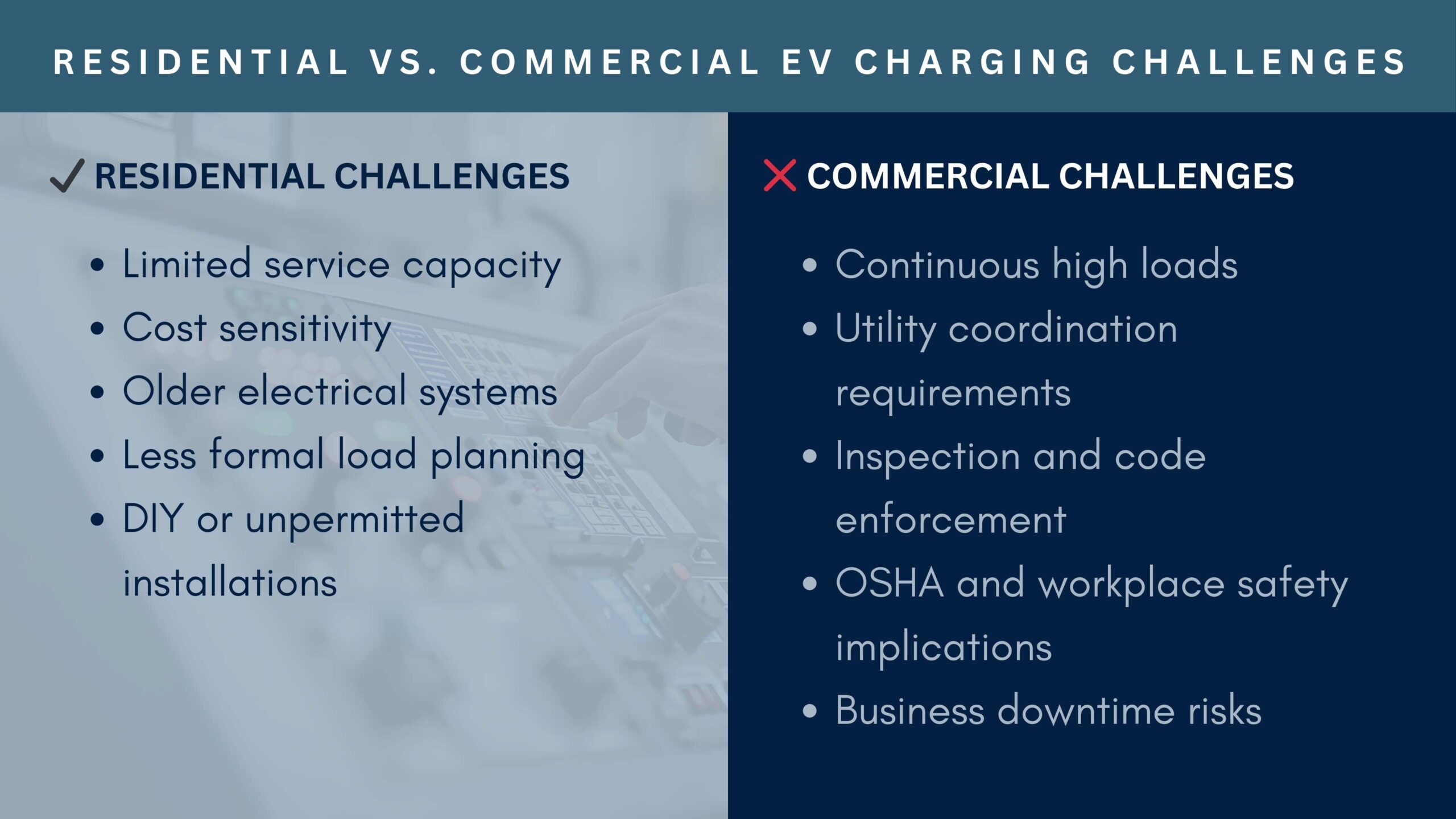
- 100A or 150A services in older homes
- Panels already loaded with HVAC, ranges, dryers, and hot tubs
- Increasing demand from home offices, solar inverters, and battery storage
Adding an EV charger can instantly push a home beyond safe operating limits. That is why installing an EV charger requires periodic panel upgrades. The problem is theses panel upgrades can cost anywhere from $2,000 to $6,000 or more, depending on service size, grounding requirements, and utility coordination. Faced with those costs, some homeowners look for shortcuts, such as improperly downsizing breakers, installing chargers without proper load management, or ignoring continuous load requirements altogether. While these approaches may seem cheaper upfront, they significantly increase fire risk, lead to nuisance breaker tripping, and create serious insurance and liability exposure over time.
Commercial EV Charging: Scale, Liability, and Grid Stress
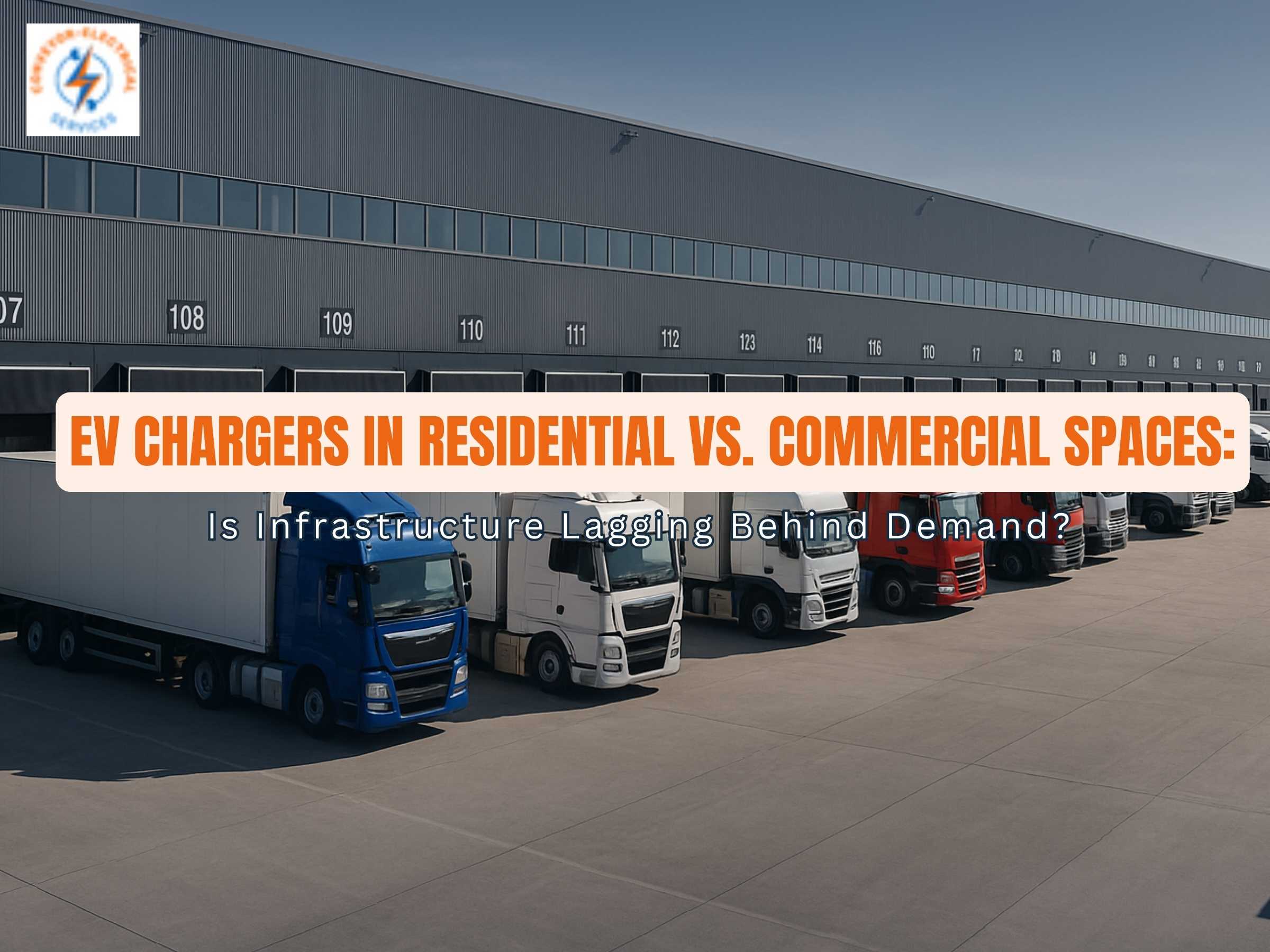
Commercial EV charging demand is being driven most heavily by industries where transportation, logistics, and employee mobility are central to daily operations. Logistics and warehousing companies are leading the charge as delivery fleets transition to electric vans to reduce fuel costs, meet sustainability targets, and comply with emissions regulations in urban areas. E-commerce and retail distribution centers rely on EV charging to support last-mile delivery vehicles that operate on tight schedules and predictable routes. Corporate campuses and office parks are adding EV chargers to attract and retain talent, meet ESG commitments, and support employees who commute in electric vehicles. Hospitality, multifamily, and mixed-use developments use EV charging as a competitive amenity, responding to guest and tenant expectations rather than purely operational needs. Municipalities and public agencies deploy EV chargers to electrify service vehicles, buses, and maintenance fleets while meeting government climate mandates. In each of these industries, EV charging has become an essential infrastructure tied directly to operations, workforce expectations, and regulatory pressure, which is why the strain on commercial electrical systems is growing so rapidly.
But Commercial EV charging introduces an entirely different level of complexity, with far higher stakes and significantly larger electrical loads. Commercial facilities must account for multiple chargers operating simultaneously, fleet charging with predictable peak demand, public or employee access that requires guaranteed uptime, and integration with existing automation and power systems. As a result, a warehouse, distribution center, or office park adding EV charging may require hundreds of additional kilowatts of capacity—often far beyond what the original electrical service was designed to handle. This reality quickly raises a critical question that slows many projects down: Who is responsible for paying for the necessary electrical and utility upgrades? This is one of the most controversial aspects of commercial EV charging.
- Property owners may resist service upgrades
- Tenants want chargers but don’t want infrastructure costs
- Utilities require studies, transformer upgrades, or new feeders
- Municipalities push mandates without funding clarity
As a result, projects stall, chargers underperform, or systems are installed that can’t scale.
Grid Stress Is No Longer a Theoretical Concern
Grid stress is no longer a theoretical concern. EV charging doesn’t just impact individual homes or facilities; it directly affects the broader electrical grid. Utilities are already seeing local transformer overloads, sharp peak demand spikes during evening charging hours, increased challenges with voltage regulation, and years of deferred infrastructure investment catching up all at once. In dense residential neighborhoods, multiple homes charging EVs simultaneously can strain distribution equipment that was designed decades ago. Commercial charging hubs amplify the problem even further, particularly when fast chargers are introduced at scale, placing concentrated, high-demand loads on systems that were never built for that level of continuous use.
Residential vs. Commercial: Why the Infrastructure Gap Feels Different
While residential EV charging tends to stress individual panels, commercial EV charging stresses entire systems and grids.
Are Codes and Utilities Keeping Up?
Electrical codes do address EV charging, but often in a reactive rather than proactive way. Recent NEC updates now include provisions for EV load calculations, continuous load requirements, and limited energy management allowances, which represent important steps forward. However, many local jurisdictions still lag behind adoption trends, creating inconsistencies in enforcement and permitting. Utilities face similar challenges, frequently responding only after demand spikes occur instead of planning infrastructure upgrades in anticipation of widespread EV charging. This gap between adoption and preparedness continues to slow projects and strain electrical systems across both residential and commercial settings. This creates friction:
- Delayed permits
- Conflicting requirements
- Unclear upgrade responsibilities
- Missed timelines for businesses and homeowners alike
Load Management: A Partial Solution
Load management systems are often marketed as a fix-all solution for EV charging challenges, and while they can be helpful, they are not a cure-all. These systems can reduce simultaneous charging loads, dynamically prioritize circuits, and, in some cases, delay the need for immediate service upgrades. However, they do not create electrical capacity where none exists. Load management cannot correct undersized feeders, override NEC continuous load requirements, or replace the need for long-term infrastructure planning. At best, these systems buy time and relying on them as a permanent solution can mask deeper electrical limitations that will eventually need to be addressed.
The Real Risk: Infrastructure Decisions Driven by Short-Term Thinking
Too often, chargers are installed without full load calculations, with the assumption that “future upgrades” will be handled later, or at a pace that outstrips what the existing electrical system can safely support. Another common mistake is treating residential and commercial installations as if they carry the same risk and demand profile, when in reality they do not. When infrastructure planning lags behind actual charging demand, safety margins shrink, and the likelihood of outages, equipment damage, or fire hazards increases.
Smart EV infrastructure planning starts with a realistic assessment of electrical capacity and long-term usage. It accounts for present and future loads, evaluates service and feeder limitations, coordinates with utilities where necessary, and designs systems that can scale safely as EV adoption grows. Whether residential or commercial, responsible EV charging requires:
- Accurate load calculations
- Feeder and service capacity assessments
- Voltage drop analysis
- Utility coordination where required
- Scalability planning, not just minimum compliance
Final Thought
In many areas, electrical infrastructure is lagging behind EV charging demand. EV adoption is outpacing panel upgrades, service expansions, utility modernization, and even the availability of skilled electrical labor. The transition to electric transportation isn’t slowing down, and the real question is whether infrastructure decisions will be proactive or reactive after failures occur. EV chargers are not simple appliances; they are infrastructure-level electrical loads. Treating them any less creates risks for homeowners, businesses, utilities, and the grid itself.
At Conveyor Electrical Services (CES), we specialize in evaluating electrical capacity, performing code-compliant load calculations, coordinating with utilities, and designing EV charging systems that balance safety, reliability, and long-term performance. Whether you’re a homeowner planning your first EV charger or a business preparing for fleet or public charging, our team helps you avoid costly shortcuts, reduce downtime, and build systems that are ready for the future.
👉 Contact Conveyor Electrical Services today to schedule an EV infrastructure assessment and get expert guidance tailored to your property.